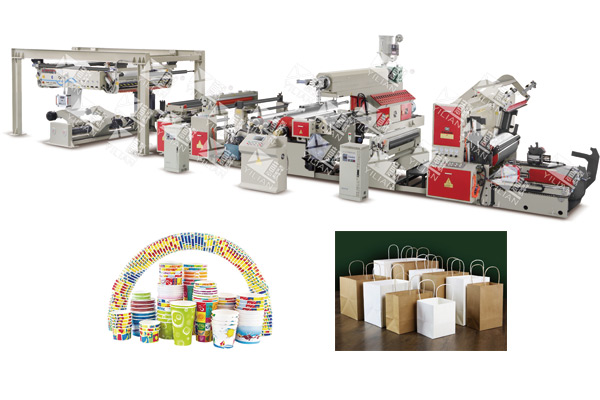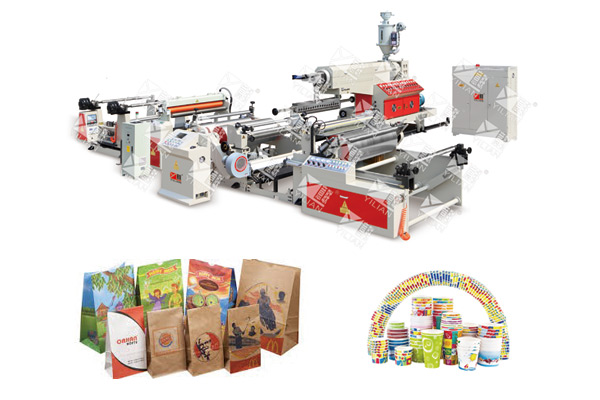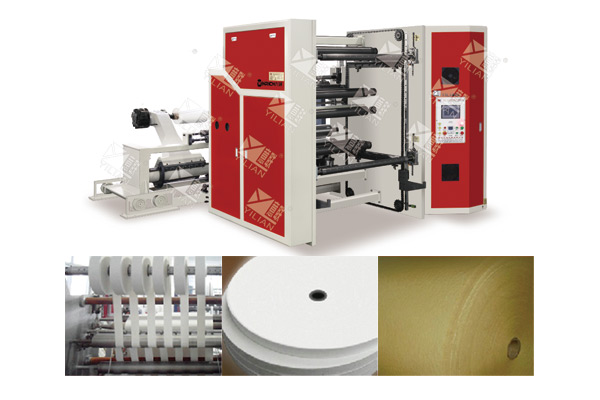
How precise is Extrusion Coating Laminator’s thickness control?
Datetime: 12/13/2025 11:49:00 AM Visit: 2010
You're not just buying a machine; you're investing in the uniformity, quality, and yield of every roll of product you produce. Simply put, modern high-performance machines—like those manufactured by Winrich—can achieve astonishing thickness control accuracy under optimal conditions, with tolerances of ±2% or even better. But that number doesn't tell the whole story. It's the result of a perfect combination of mechanical design, melt control, sensor feedback, and extensive application experience.
Understanding the Extrusion Coating Process
To understand control, you must first understand what’s being controlled. The extrusion coating process isn’t like spraying paint; it’s about dragging a molten polymer curtain—the melt curtain—onto a moving web. Imagine stretching a perfect, warm sheet of toffee between two rollers. Any variation in the toffee’s temperature, stretch, or speed ruins the consistency. That’s your challenge.
The lamination machine must manage three fluid states simultaneously: the solid plastic pellets, the molten polymer in the extruder, and the final solidified film on your substrate. The thickness control target is the final, cooled layer. The gap at the die lip is just the starting point. From there, factors like draw-down, neck-in (the molten web narrowing), and chill roll contact introduce variables. A precise machine doesn’t just have a sturdy die; it has systems that anticipate and compensate for these downstream effects in real-time. This holistic view separates basic equipment from precision instruments.
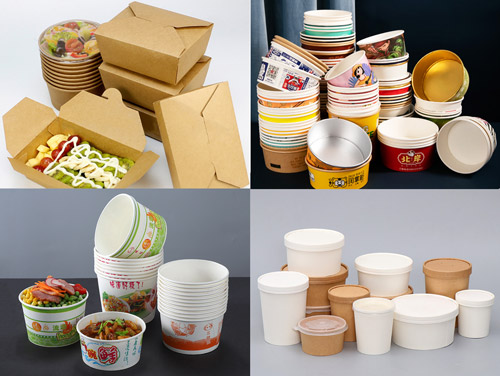
Key Factors Determining Thickness Accuracy
Blindly trusting a single percentage claim is a recipe for frustration. Real-world precision is a symphony, not a solo act. Here are the principal players:
-
The Extruder’s Steady Hand: It all starts with a consistent, homogeneous melt. A Winrich coating machine employs precision-grade barrel heating zones and screw designs that minimize temperature surfing and pressure pulsations. A ±1°C spike in melt temperature can change viscosity enough to alter flow, impacting thickness before the polymer even sees the die.
-
The Die: Where Uniformity is Born: The extrusion laminator’s die is its most critical mechanical component. Modern automatic die systems use thermally or mechanically actuated bolts across the lip to micro-adjust the gap. But the base uniformity of a Winrich die, crafted with advanced machining, ensures these bolts are fine-tuning an already excellent profile, not fighting gross imperfections.
-
The Chill Roll: The Unsung Hero: This is where the molten curtain is quenched and its final thickness set. Precision here involves perfect temperature control (often within ±0.5°C across the roll face), micro-grooved surfaces for optimal air evacuation, and impeccable crown to ensure even nip pressure. Any deviation creates a thickness band.
-
Sensing: The Eyes of the Operation: You cannot control what you cannot measure. On-line, non-contact beta gauges are the industry standard for coating thickness accuracy. But their placement is crucial. Is the gauge measuring the hot film or the cooled one? Is it scanning the full web width? Winrich integrates gauge feedback loops directly with the die control system, creating a closed-loop that reacts within seconds to a drift.
The Importance of Operators and Raw Materials
Here’s a perspective you rarely hear: the best extrusion coating machine in the world is only as precise as the team running it. Operator skill in setting up the melt curtain, managing line tension, and interpreting data is irreplaceable. Furthermore, your raw material dictates the possible precision. Low-MFI resins, recycled content with variable flow, or highly abrasive compounds all introduce challenges. A precise machine provides the platform for control, but a skilled team, often with support from the machine builder’s process engineers, defines the result.
Engineering Certainty, Not Just Control
At Winrich, we talk less about “precision” in the abstract and more about “repeatability under your conditions.” Our philosophy is to engineer out variables. For instance, our proprietary Melt-Guardian™ system doesn’t just monitor extruder temperatures; it models the energy input and anticipates thermal lag, making micro-corrections before the gauge even detects a shift. We’ve seen too many operations where the machine hunts for a target, constantly over-correcting. Our goal is a flat, quiet control line on the operator’s screen.
For a client producing high-barrier coffee packaging, the requirement wasn’t just an average thickness but an exceptionally uniform profile edge-to-edge to prevent weak seals. The standard solution was to run slower. We analyzed their process and implemented a dual-zone chill roll with independent temperature control on each side, combating the natural heat buildup at the web edges. The result? They maintained speed and achieved a profile variation of less than ±1.5%, dramatically reducing their seal failure rate. This is precision extrusion lamination in action—solving the real problem, not just the number on a spec sheet.
Interpreting the Spec Sheet: What Does ±2% Mean to You?
When a manufacturer quotes a tolerance like ±2%, you must ask: On what? Is it on a 20-micron coating or a 100-micron one? (±0.4µm vs. ±2µm is a world of difference.) Is it a short-term measurement on a lab sample or a 72-hour production run across multiple roll changes? Is it the machine capability with a perfect operator and prime resin, or a guaranteed performance with your team and your material mix?
My advice? Treat the spec sheet as a starting point for conversation. Ask for Coating Weight CV% (Coefficient of Variation) data from long-term runs. This statistical measure tells you more about stability than a simple tolerance band. A Winrich machine might be rated at ±2%, but its true value often shines in a CV% below 1.5%, meaning phenomenal day-in, day-out consistency that directly impacts your material savings and quality approvals.
Where is Extrusion Coating Technology Heading?
The next leap in thickness control won’t come from a better bolt on the die. It will come from artificial intelligence and predictive digital twins. Imagine a system that learns how a specific lot of resin behaves, remembers the optimal thermal settings for a particular substrate, and automatically sequences the start-up to achieve target gauge within the first 50 meters. This is where Winrich is investing. We see precision evolving from reactive control to proactive process stewardship, minimizing waste from the very first meter of production.
Conclusion
So, how precise is an Extrusion Coating Laminator’s thickness control? The technical ceiling is incredibly high—within a few microns. But unlocking that for your specific product is a collaborative journey. It depends on the machine’s foundational engineering, the sophistication of its control loops, the materials you run, and the expertise supporting you.
Don’t just buy a machine that claims precision. Partner with a builder like Winrich that can demonstrate how that precision is achieved and sustained in an environment like yours. Ask for case studies, request a trial with your materials, and talk to their process engineers. True precision isn’t a static number; it’s the quiet confidence that every roll you ship will perform exactly as expected.
Ready to see what consistent, precise extrusion coating can do for your yield and product quality? Let’s discuss your application. [Contact the Winrich Process Engineering Team today] to schedule a personalized consultation and explore our range of high-precision extrusion coating lamination solutions.