How Does a Paper Slitting Machine Avoid Roll-Change Downtime?
Datetime: 10/13/2026 4:40:00 PM Visit: 10
You're running a printing or packaging operation, and every time the slitter stops for a roll change, production time disappears. A converting line that runs at 260m/min but stops for 10 minutes every roll change isn't really running at 260m/min. A Paper Slitting Machine built for continuous production changes that math by letting one rewinding shaft wind while the other is being reloaded. This article explains how the A/B shaft design eliminates roll-change downtime, what the circular knife system delivers in cut quality, and what to verify when you're matching a slitter to your converting operation.
Why Does Roll Change Downtime Matter for Converters?
The Cost of Every Stop
In a typical converting operation, roll changes take 5-15 minutes each. That's the time to remove the finished roll, insert a new core, re-thread the web, and bring the machine back up to speed. In a facility running multiple rolls per shift, those stops add up to hours of lost production every day.
The impact goes beyond the minutes lost. Every stop reduces Overall Equipment Effectiveness (OEE), which measures how efficiently equipment is used. A machine that runs at high speed but stops frequently has lower availability than a slower machine that runs continuously. For converters measuring OEE as a key performance indicator, the roll-change stop is one of the biggest controllable losses.
Single-Shaft vs. A/B Shaft Rewinding
A single-shaft slitter requires a complete stop for every roll change. The finished roll comes off the shaft, a new core goes on, the web is re-threaded, and production resumes. There's no way around the stop because the shaft is the only place the finished material can go.
A slitter with A/B shaft independent rewinding changes that sequence. The machine has two rewinding shafts — A and B. While shaft A is winding the finished strips, the operator loads a new core onto shaft B. When shaft A completes its roll, the machine switches to shaft B without stopping. The finished roll on shaft A comes off while shaft B is already winding. Production continues uninterrupted.
| Parameter | FQJ-1100A | FQJ-1300A | FQJ-1600A |
|---|---|---|---|
| Unwind diameter | 1400mm | 1400mm | 1400mm |
| Slitting width | 1000mm | 1200mm | 1500mm |
| Rewind diameter | 1000mm | 1000mm | 1000mm |
| Rewind minimum width | 30mm | 30mm | 30mm |
| Slitting speed | 10-260m/min | 10-260m/min | 10-260m/min |
| Slitting accuracy | ±0.3mm | ±0.3mm | ±0.3mm |
| Power | 10kW | 11kW | 12kW |
| Voltage | 380V/50Hz 3-phase | 380V/50Hz 3-phase | 380V/50Hz 3-phase |
| Air pressure | 5.5kg/cm² × 0.5m³/min | 5.5kg/cm² × 0.5m³/min | 5.5kg/cm² × 0.5m³/min |
| Weight | 2800kg | 3000kg | 3300kg |
How Does the A/B Shaft System Eliminate Stops?
Independent Rewinding in Practice
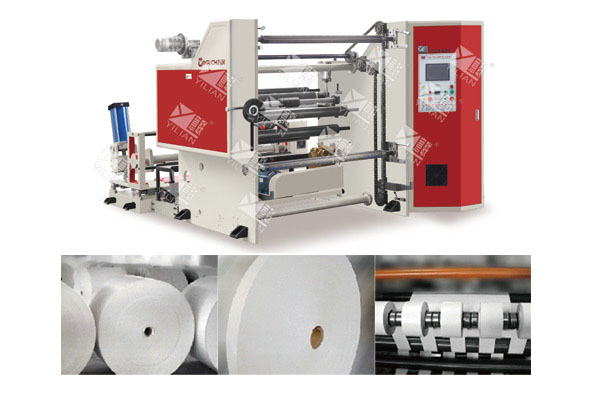
The FQJ series adopts A and B axis independent rewinding, which makes installation, dismounting, and operation straightforward. The key is that the two shafts operate independently — one can be winding while the other is being prepared for the next roll.
The rewinding is orderly and compact, with the shaft using automatic tension control and an inflatable shaft design. The inflatable shaft grips the core firmly when pressurized and releases it when deflated, so roll changes don't require tools or complex procedures. Operators can remove finished rolls and load new cores without specialized training, which reduces downtime between runs even when less experienced operators are managing the changes.
How the 1400mm Unwind Capacity Reduces Stops
The machine accepts a maximum unwind diameter of 1400mm across all three models. That large capacity means you can process jumbo rolls from paper mills without intermediate rewinding. Fewer roll changes on the unwind side means fewer interruptions to the entire line.
If a converter runs a jumbo roll that lasts for hours instead of minutes, the frequency of stops drops proportionally. The combination of a large unwind capacity and A/B shaft rewinding means the machine can run through multiple finished rolls without a single production stop.
What Does the Circular Knife System Deliver?
Cutting Precision and Adjustability
The machine uses circular knife cutting, which provides high cutting precision and convenient operation. The cutter can be adjusted freely, so the operator can set the slit width without changing the blade assembly. That adjustability matters when you're running different product widths on the same machine or making small adjustments to accommodate material variations.
The slitting accuracy is ±0.3mm across all three models. For printed packaging film, coated paper, and paper-plastic composites, that tolerance keeps the slit edges clean and the rewound rolls uniform. A slitter that holds ±0.3mm produces rolls that feed consistently into downstream processes without edge trimming or waste.
Frequency Conversion and Microcomputer Control
The machine uses frequency conversion for speed regulation, paired with microcomputer automatic control. The frequency converter adjusts the motor speed to match the line speed, which keeps the web tension stable as the roll diameter changes. As the unwind roll shrinks, the frequency converter compensates by adjusting the unwind brake, so the web tension stays constant from the start of the roll to the end.
The control system includes imported photoelectric deviation correction, automatic meter counting, alarm stop, and tension digital display. The photoelectric deviation device keeps the web aligned as it enters the cutting station, and the automatic meter counts the length of material processed. The alarm stop function shuts the machine down if it detects a fault or the roll reaches the set length.
What Materials Run Best on This Machine?
Paper, Film, Cloth, and Composites
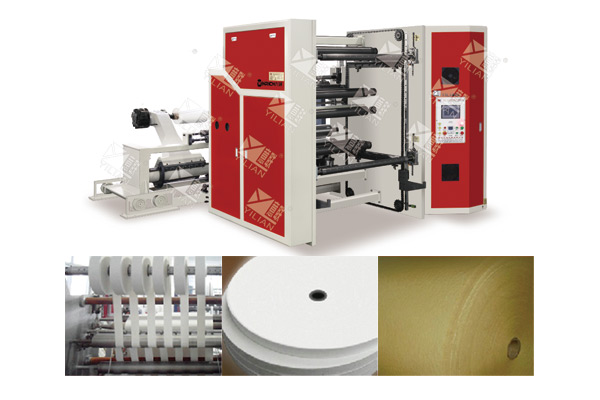
The FQJ series is applicable to edge cutting and slitting of large roll materials. That covers a range of substrates:
-
Printing and packaging plastic film — BOPP, PET, PE, and CPP film for packaging converters
-
Paper — coated paper, kraft paper, and paperboard for printing and packaging
-
Cloth — textile rolls for cutting into narrower widths
-
Paper-plastic composites — laminates combining paper and film layers
-
Lin Mozhi and coated paper — specialty coated stocks for printing applications
-
Synthetic leather — artificial leather rolls for furniture and automotive applications
The common thread is a roll material that needs to be reduced from a wide parent roll to narrower finished rolls. The circular knife system handles both thin films and heavier paper stocks, and the tension control adapts to the different material stiffnesses.
Pneumatic Feeding and Waste Discharge
The feeding frame uses a pneumatic automatic lifting function, which raises and lowers the unwind roll with air pressure rather than manual effort. That feature matters for heavy jumbo rolls — a 1400mm diameter roll of coated paper is heavy enough that manual lifting would be impractical or unsafe.
The machine also includes an automatic waste edge discharge device. When the circular knives trim the edges of the parent roll, those trimmed edges need to be removed from the production area. The waste discharge system pulls the edge trim away automatically, keeping the machine area clean and reducing the labor needed to manage waste.
A Paper Slitting Machine like the FQJ 1100A-1700A from Winrich Machinery is built for converters who measure productivity in uptime, not just top speed. The machine's A/B shaft rewinding, 1400mm unwind capacity, and microcomputer control work together to keep material moving through the cutting station without unnecessary stops.
What Should You Check Before Selecting a Slitter?
How do I choose between the 1100A, 1300A, and 1600A models?
The model number corresponds to the slitting width capacity. The FQJ-1100A handles 1000mm slitting width, the FQJ-1300A handles 1200mm, and the FQJ-1600A handles 1500mm. All three share the same 1400mm unwind diameter, 1000mm rewind diameter, 10-260m/min speed range, and ±0.3mm accuracy. Choose the model that covers your widest parent roll without running at the extreme edge of the range. Power consumption rises with width — 10kW, 11kW, and 12kW respectively — so check your facility's electrical capacity.
What's the minimum rewind width?
The minimum rewind width is 30mm across all three models. That's the narrowest strip the machine can wind consistently. If your product requires narrower strips, you'd need a different machine configuration or a secondary slitting step.
What materials can the circular knife handle?
The circular knife system handles paper, film, cloth, and paper-plastic composites. For very abrasive materials or thick laminates, check the blade material and sharpening schedule with the manufacturer. The cutter can be adjusted freely, so the same blade setup works across different slit widths and material types.
What maintenance does the machine need?
Inspect the circular knives for wear — a dull blade produces a ragged edge and requires more cutting force. Clean the photoelectric deviation sensor regularly, because dust on the lens affects web alignment. Check the inflatable shafts for air leaks and the tension control system for consistent readings. Lubricate the guide rollers and blade shafts according to the manufacturer's schedule, and keep the waste discharge system clear of trim buildup.
Let's Match a Slitting Machine to Your Converting Line
Share Your Roll Width and Slitting Requirements
A Paper Slitting Machine should match your parent roll dimensions, target slit widths, and material type — not the other way around. The FQJ 1100A-1700A microcomputer high-speed paper slitting machine from Winrich Machinery runs at 10-260m/min with ±0.3mm accuracy, handles 1000mm to 1500mm slitting widths, and accepts jumbo rolls up to 1400mm in diameter. The A/B shaft independent rewinding keeps production running during roll changes, and the circular knife system with frequency conversion and microcomputer control delivers consistent cut quality across paper, film, cloth, and composite materials. If you're specifying a slitter rewinder for printing, packaging, or converting operations, send us your roll width and slitting requirements — we'll help you confirm the right model and configuration before you order.