How Does a Slitter Keep Running While Rolls Are Being Changed?
Datetime: 9/4/2026 10:12:00 AM Visit: 264
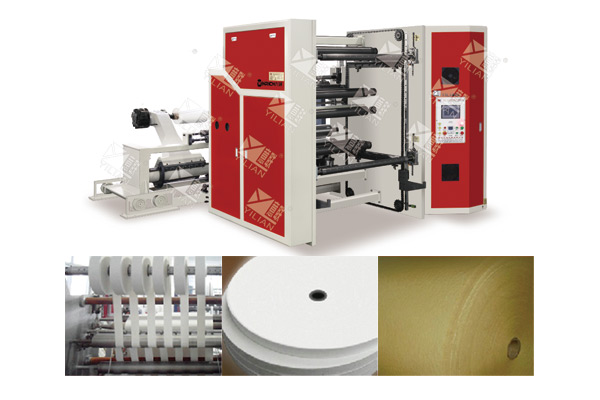
You're running a converting operation, and every time the slitter stops for a roll change, you're losing production time. A paper slitting machine that can't keep running during roll changes is a machine that leaves money on the table. The FQJ 1100A-2200A microcomputer high-speed paper slitting machine from Winrich Machinery was engineered with continuous production as the priority: A/B shaft independent rewinding that allows one shaft to wind while the other is being prepared, a 1400mm unwind diameter that minimizes roll changes, and microcomputer control that maintains consistent quality across the entire run. This article walks through what makes this machine capable of running continuously—from the A/B shaft design that eliminates downtime to the large unwind capacity that reduces the frequency of stops.
Questions Converting Managers Ask About Continuous Slitting
Two Efficiency Concerns—Answered Up Front
Q: How does the machine handle roll changes without stopping production?
A: The FQJ series adopts A and B axis independent rewinding. While one shaft is winding, the other can be prepared for the next roll—meaning the machine doesn't stop during roll changes. This independent rewinding makes installation, dismounting, and operation straightforward.
Q: How often do I need to stop for new material?
A: The machine accepts a maximum unwind diameter of 1400mm across all models. This large capacity means you can process jumbo rolls without frequent changes—reducing handling time and maximizing uptime.
The Problem with Single-Shaft Slitters — Why Production Stops
Single-shaft slitters require a complete stop for every roll change. The finished roll must be removed, a new core inserted, and the web re-threaded before production can resume. Each stop costs time—and time is money.
[H3] Every Roll Change Means Downtime — and Lost Revenue
In a typical converting operation, roll changes can take 5-15 minutes each. In a facility running multiple rolls per shift, these stops add up to hours of lost production time every day. The FQJ series' A/B shaft design eliminates these stops, keeping the machine running while rolls are being changed.
[H3] How Frequent Stops Reduce Overall Equipment Effectiveness
OEE (Overall Equipment Effectiveness) is a measure of how efficiently equipment is used. Every stop for a roll change reduces availability, which directly lowers OEE. The FQJ series' continuous rewinding capability improves availability—and OEE—by eliminating the stops that plague single-shaft designs.
A/B Shaft Design — One Shaft Winds While the Other Prepares
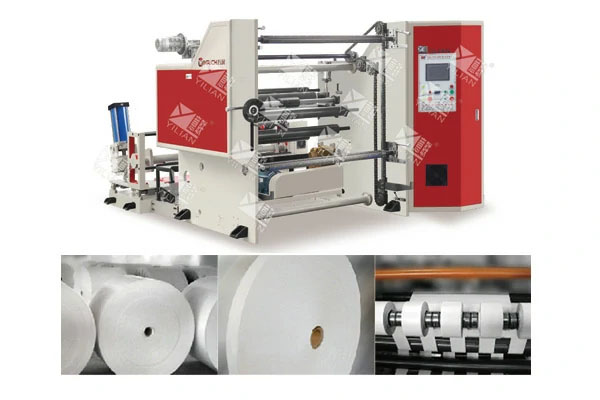
The FQJ series adopts A and B axis independent rewinding, featuring easy installation, dismounting, and operation. This is the key to the machine's continuous production capability.
Independent Rewinding for Continuous Production
With A/B shaft independent rewinding, one shaft can be winding while the other is being prepared for the next roll. The machine doesn't stop during roll changes—production continues uninterrupted. The rewinding is orderly and compact, with the shaft adopting automatic tension control and inflatable shaft design.
Easy Installation and Dismounting — No Complex Procedures
The A/B shaft design makes roll installation and dismounting straightforward. Operators can remove finished rolls and load new cores without complex procedures or specialized tools, reducing downtime between runs and allowing even less experienced operators to manage roll changes efficiently.
1400mm Unwind Capacity — Fewer Roll Changes, More Production
The FQJ series accepts a maximum unwind diameter of 1400mm. This large capacity means you can process jumbo rolls from paper mills without intermediate rewinding.
Processing Jumbo Rolls Without Intermediate Rewinding
With a 1400mm unwind capacity, you can load larger parent rolls and run longer before needing a change. This reduces the number of roll changes per shift—and the time spent on each change. For high-volume converters, this translates directly to higher throughput.
Less Handling, Less Waste, Higher Throughput
Fewer roll changes mean less handling of materials, which reduces the risk of damage and waste. It also means operators spend less time on roll changes and more time monitoring production quality.
Speed and Precision That Keep Production Moving
Continuous production is only valuable if the output meets quality standards. The FQJ series runs at 10-150 meters per minute while maintaining ±0.3mm slitting accuracy.
10-150m/min — Speed That Adapts to the Material
The speed range covers everything from slow, precise runs for delicate materials to high-speed production for standard paper grades. Operators can match the speed to the material, ensuring quality without sacrificing throughput. This is achieved through frequency conversion and microcomputer automatic control with imported photoelectric deviation device, automatic meter, alarm stop, and tension digital display.
±0.3mm Precision — Consistent Quality, Run After Run
The ±0.3mm accuracy ensures that slit widths meet customer specifications consistently. When you're running long production runs without stopping, that consistency becomes even more critical—any drift in accuracy would be compounded across thousands of meters of material.
Applications Where Continuous Production Matters Most
The FQJ series serves multiple converting applications where uptime is critical:
High-Volume Paper and Packaging Converters
In high-volume operations, every minute of downtime costs money. The FQJ series' continuous rewinding capability keeps production moving through roll changes—maximizing throughput and reducing cost per roll.
Film and Label Producers
For converters running films like OPP, CPP, and PP shrinkage films, as well as label paper and synthetic leather, consistent quality and minimal stops are essential. The microcomputer control system ensures consistent tension and speed across the entire run.
Plants with Limited Skilled Labor
The FQJ series features pneumatic automatic lifting for the feeding frame and an automatic discharging device for waste, reducing the physical demands on operators and simplifying operation.
Specifications at a Glance — FQJ Series
| Parameter | FQJ-1100A | FQJ-1300A | FQJ-1600A |
|---|---|---|---|
| Max. Unwind Diameter | 1400mm | 1400mm | 1400mm |
| Max. Slitting Width | 1000mm | 1200mm | 1500mm |
| Min. Slitting Width | 30mm | 30mm | 30mm |
| Max. Rewind Diameter | 1000mm | 1000mm | 1000mm |
| Slitting Speed | 10-150m/min | 10-150m/min | 10-150m/min |
| Slitting Accuracy | ±0.3mm | ±0.3mm | ±0.3mm |
| Power | 10kW | 11kW | 12kW |
| Weight | 2800kg | 3000kg | 3300kg |
Straight Answers on Continuous Slitting
Q: How Does A/B Shaft Rewinding Work?
A: The FQJ series adopts A and B axis independent rewinding. While one shaft is winding, the other can be prepared for the next roll—meaning the machine doesn't stop during roll changes.
Q: How Much Production Time Does A/B Shaft Design Save?
A: In a typical converting operation, roll changes can take 5-15 minutes each. The A/B shaft design eliminates these stops, saving hours of lost production time per shift. Combined with the 1400mm unwind capacity that reduces the frequency of changes, the savings are substantial.
Request a Quote for Your Slitting Line
A paper slitting machine that keeps running while rolls are being changed is the foundation of any efficient converting operation. The FQJ 1100A-2200A series from Winrich Machinery delivers A/B shaft independent rewinding for continuous roll changes, 1400mm unwind diameter for long, uninterrupted runs, 10-150m/min speed range with ±0.3mm precision, microcomputer control with imported photoelectric deviation device, and three models covering slitting widths from 1000mm to 1500mm.
Whether you're slitting paper, film, or label materials, the FQJ series offers the uptime and reliability that converting professionals need. With features like pneumatic automatic lifting, automatic waste discharging, and inflatable shafts for orderly rewinding, it's built for continuous, high-volume production.
Contact Winrich Machinery for a quote or configuration consultation → their team can help you select the right model width and options for your specific material requirements and production targets. Get a slitting machine that keeps running while rolls are being changed.