Why Does a WSFM Shaftless Automatic Extrusion Coating Machine Run Both Sides in One Pass?
Datetime: 11/25/2026 9:25:00 AM Visit: 10
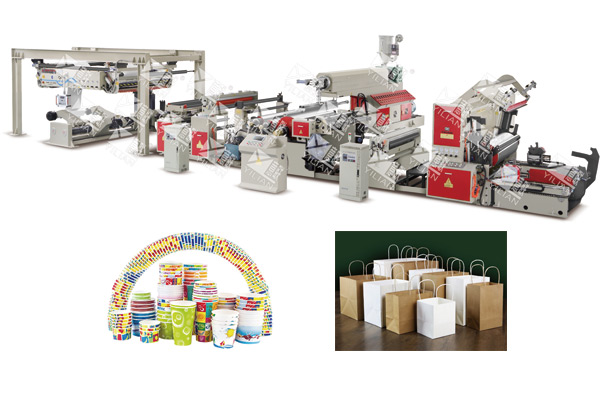
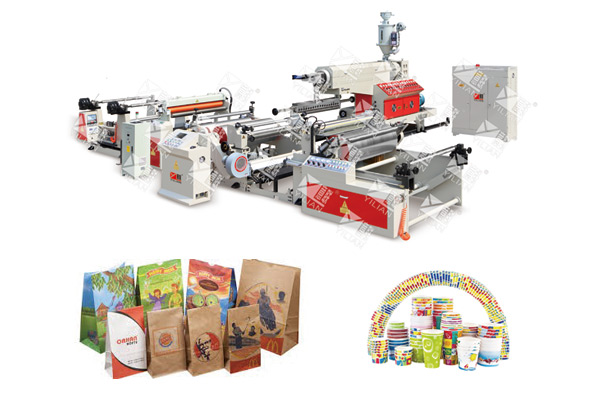
A WSFM Shaftless Automatic Extrusion Coating Machine running a single pass typically coats one face of the substrate. The WSFM1100-2000B coats two faces at once. That's a structural difference, not a speed setting—the machine carries dual mainframes with independent extruders so both sides of the web are coated before the material is rewound. You'll see how that arrangement works, what the extruder and die options cover, and where the width and speed envelope sits.
What Questions Come Up Before Coating Both Sides?
What does the second mainframe actually add?
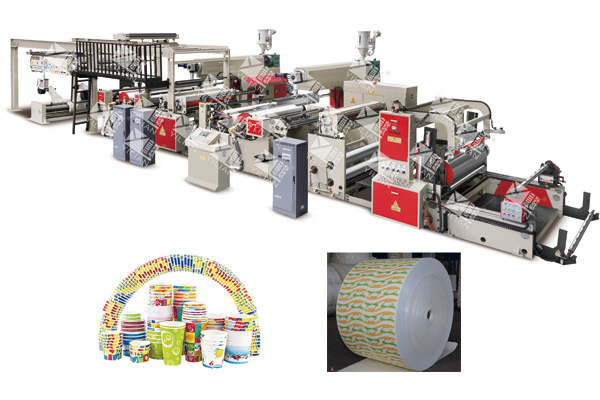
A single-mainframe coater runs the web past one extrusion station and coats one face. The WSFM1100-2000B uses dual mainframes with independent extruders, which allows both sides of the substrate to be coated in the same run. The page lists the application as producing PE-coated paper cup paper, paper bowl paper, and instant noodle bowl paper, with double-side PE coating in one time. The second mainframe is what removes the need to run the roll through the line twice.
Why does double-side coating matter for cup and bowl stock?
Paper cup and bowl stock needs a PE layer on the inside face—the surface that contacts the liquid—and a PE layer on the outside face for print receptivity and moisture protection. Coating both sides in one pass means the material goes from base roll to finished coated roll without an intermediate rewind, storage, and second-run setup. The page frames the double-side capability as the machine's application.
The Extruder, Die Head, and Coating Options
The page lists a PLC man-machine interface with centralized control and machine, electricity, and gas integrated design, plus a high-precision non-edge imported die head. The non-edge die head is the detail that matters for coating efficiency—a die that coats to the web edge without trim waste avoids the edge trim that a conventional die leaves behind.
The extruder configuration is flexible: the machine can be matched with a single extruder, a twin extruder, or multilayer coextrusion. The suitable coating resins are LDPE, PP, EVA, and EAA. The mixing equipment is listed as high-speed and efficient with US technology, and the static mixing device as new technology from Italy.
| Parameter | WSFM1100-2000B (from the product page) |
|---|---|
| Machine specification | 1100/90mm, 1300/100mm, 1500/105mm, 1800/110mm |
| Coating speed | 150, 180, 200 m/min |
| Coating resin | LDPE, PP, EVA, EAA |
| Base material | BOPP, BOPET, BOPA, CPP, CPE, paper, AL, nonwoven |
| Coating width | 1100, 1300, 1500, 1800 mm |
| Coating thickness | 0.012–0.1 mm |
| Thickness tolerance | ≤±5% |
| Cooling roller | Φ500, Φ600, Φ700 mm |
| Screw L/D | Φ90/100/105/110 at 33:1 |
| Main unwind diameter | Φ800–1500 mm |
| Auxiliary unwind diameter | Φ600 mm |
| Rewind diameter | Φ800–1700 mm |
Why the screw L/D is 33:1 across all sizes
The page lists the screw specification as 33:1 L/D for every diameter from Φ90 to Φ110. A 33:1 screw gives the resin enough residence time to melt and homogenize before it reaches the die. On a line running up to 200m/min, the extruder has to deliver a uniform melt at a high rate—the longer screw is what makes that possible without sacrificing melt quality, which in turn keeps the coating thickness consistent.
Thickness Control and the ±5% Tolerance
The coating thickness range is 0.012–0.1mm, with an inaccuracy of ≤±5%. That tolerance is the machine-level window the control system holds across the coating width.
At 200m/min, a thin coating layer passes through the die and onto the web in a fraction of a second. Any variation in the melt flow, the die gap, or the web speed shows up as a thickness change. The ±5% figure is what the line is designed to hold—for a 0.03mm coating, that's ±0.0015mm across the full width. On a paper cup, that thickness consistency is what keeps the seal strength and the barrier performance uniform from cup to cup.
-
Coating thickness: 0.012–0.1mm
-
Tolerance: ≤±5%
-
Cooling roller: Φ500, Φ600, or Φ700mm
-
Coating width: 1100–1800mm
-
Speed: 150–200m/min depending on model
-
Die head: imported, non-edge design
[H3] Why the cooling roller diameter steps with the machine width
The cooling roller diameters are listed as Φ500, Φ600, and Φ700mm, matching the machine width steps. A wider web needs a larger cooling roller to keep the wrap angle and the cooling time consistent. A smaller roller on a wider web would give the coating less time to set before the nip, and the surface would be tacky when the web reaches the next station.
The Auto Splicer and Continuous Running
The machine's model name includes an auto splicer, and the page lists the main unwind diameter as Φ800–1500mm with an auxiliary unwind at Φ600mm. The auto splicer is the component that lets the line change from an expiring roll to a new one without stopping.
On a line running at 200m/min, a roll change that requires stopping the machine costs production time and creates a coating discontinuity at the restart. The auto splicer makes the change while the web continues moving, so the coating process stays continuous. The page's auxiliary unwind diameter of Φ600mm is the staging position for the next roll.
-
Main unwind: Φ800–1500mm
-
Auxiliary unwind: Φ600mm, staging position
-
Auto splicer: roll change without stopping
-
Rewind diameter: Φ800–1700mm
-
Dry-type composite system: included, with dry laminating function
-
Filter screen exchange: swift exchange design
What the dry-type composite system adds
The page lists a dry-type composite system, with the function of a dry composite machine. That's a separate lamination capability built into the same line—the extruder applies the coating, and the dry composite system can bond a second substrate to it. For a converter producing structures that combine PE coating with a laminated film, the machine can run both processes rather than requiring a separate laminator.
Where the WSFM1100-2000B Fits a Coating Line
The WSFM Shaftless Automatic Extrusion Coating Machine WSFM1100-2000B from Winrich is built around the dual-mainframe architecture the page describes: two independent extruders coating both faces of the web in one pass, an imported non-edge die head, a dry-type composite system, and an auto splicer, running 150–200m/min across 1100–1800mm coating widths at 0.012–0.1mm thickness with ≤±5% tolerance. The suitable resins are LDPE, PP, EVA, and EAA, and the base material range covers BOPP, BOPET, BOPA, CPP, CPE, paper, aluminum foil, and nonwoven. For a converter producing paper cup, bowl, or instant noodle bowl stock, the value sits in the single-pass double-side coating—the material leaves the line with both faces coated, and the auto splicer keeps that process running through roll changes.
What to confirm before matching a product to the WSFM1100-2000B
Confirm the coating width against the 1100/1300/1500/1800mm options, the base material against the BOPP/BOPET/BOPA/CPP/CPE/paper/AL/nonwoven list, and the resin against LDPE/PP/EVA/EAA. Check the coating thickness against the 0.012–0.1mm range and the target speed against the 150/180/200m/min model rating. The page's parameters give the starting point; the actual product structure determines which extruder configuration and which die head fit.
Let's Match a Coating Job to the WSFM1100-2000B
Send over your base material, coating thickness, width, and target output—we'll help you check them against the 1100–1800mm coating width, the 0.012–0.1mm thickness range, and the 150–200m/min speed envelope. Talk to Winrich about your WSFM Shaftless Automatic Extrusion Coating Machine requirements and get a line-level answer before you commit to the equipment.