Why Does an Extrusion Coating Lamination Machine Use No Glue?
Datetime: 11/11/2026 3:16:00 PM Visit: 8
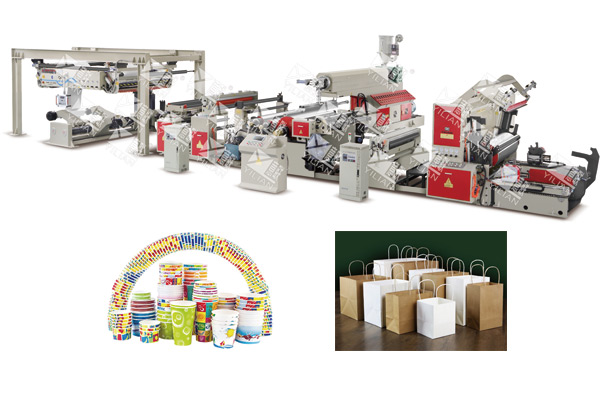
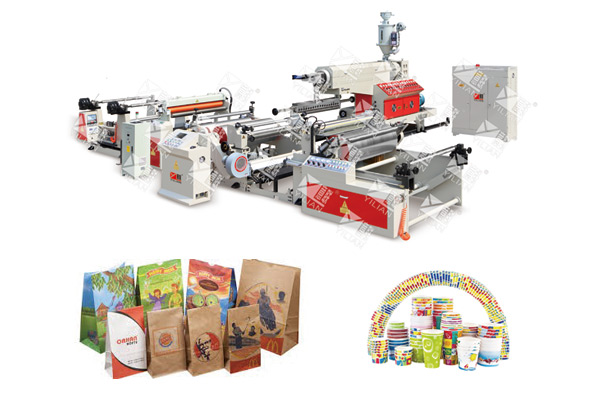
An Extrusion Coating Lamination Machine doesn't use glue. It melts resin, extrudes it as a molten film, and presses that film onto a substrate while it's still tacky—so the bond is a thermal weld rather than an adhesive joint. You'll see how the SJFM1100-2300E sequences that process, what the web width and speed mean in production, and where the substrate and resin envelope sits.
What Questions Come Up Before Running an Extrusion Lamination Line?
What's the difference between extrusion coating and adhesive lamination?
Adhesive lamination bonds two substrates with a glue layer between them. Extrusion coating extrudes a molten resin film directly onto one substrate and presses a second substrate against it while the resin is still hot. The page lists the machine's coating resins as PE, PP, and EVA, and the substrates as EPE, BOPP, BOPET, and aluminum foil. The bond forms at the resin–substrate interface as the melt cools, so there's no adhesive drying step and no solvent handling in the bond itself.
Which substrates does the machine actually run?
The page lists EPE, BOPP, BOPET, and aluminum foil as suitable substrates. EPE is the foam side, and BOPP/BOPET/AL are the film or foil side. That means the machine is built for flexible packaging structures where a foam layer needs a film facing, or a foil needs a protective or sealable resin layer. The substrate list is the starting point for judging whether a given product structure fits.
The Melt-to-Nip Sequence
The process starts at the extruder. Resin pellets are melted and pushed through a die that forms a thin curtain of molten film. That curtain drops into a nip—the gap between a chill roll and a pressure roll—where the substrate is also passing. The molten film meets the substrate at the nip, and the pressure roll presses them together while the chill roll sets the resin.
The speed at which this happens is the machine's production rate: 50m/min per the page. At that rate, the melt curtain has to be uniform across the full web width, and the nip pressure has to stay even from edge to edge. The page lists a machine spec of 1100–2300mm, with a coating width of 1000–2200mm. The gap between machine spec and coating width is the edge trim—the margin that doesn't carry saleable coating.
Why the net film thickness tolerance matters
The page lists net film thickness error as ≤±5mm. That's the allowed variation in the resin layer across the web. On a flexible packaging structure, the coating thickness determines the seal strength and the barrier performance. A coating that's thick at one edge and thin at the other will seal differently across the same pouch. The ±5mm tolerance is the machine-level window the control system has to hold.
Resin Options and the Coating Envelope
The page lists PE, PP, and EVA as the coating resins, with a coating thickness range of 0.012–0.1mm. Each resin brings a different property to the bond: PE is the workhorse seal layer, PP gives higher temperature resistance, and EVA improves adhesion to polar substrates.
| Parameter | SJFM1100-2300E specification |
|---|---|
| Machine spec | 1100–2300mm |
| Production speed | 50m/min |
| Coating resins | PE, PP, EVA |
| Substrates | EPE, BOPP, BOPET, aluminum foil |
| Coating width | 1000–2200mm |
| Coating thickness | 0.012–0.1mm |
| Net film thickness tolerance | ≤±5mm |
| Main unwind diameter | Φ800–1300mm |
The coating thickness range of 0.012–0.1mm spans a thin seal layer through a heavier protective coat. A 0.012mm PE layer is a sealable surface on a foil or BOPET structure; a 0.1mm layer is a more substantial coating that can carry a foam-facing bond or a heavier protective function. The resin choice and the thickness have to be set together against the end-use requirement.
What the unwind diameter means for run length
The main unwind diameter is Φ800–1300mm. A larger roll diameter means fewer splice stops per shift, but it also requires the unwind stand and tension control to handle the roll weight. For a machine running at 50m/min, the roll diameter determines how long the line runs between roll changes—which is a direct input to the line's overall output, not just the machine's peak speed.
Web Width, Coating Width, and the Trim Margin
The machine spec of 1100–2300mm and the coating width of 1000–2200mm define the working envelope. The coating width is always narrower than the machine spec by about 100mm—that's the edge trim on each side. For a converter, the usable coating width is what determines how many product lanes fit across the web.
-
Machine spec: 1100–2300mm, the full web handling width
-
Coating width: 1000–2200mm, the saleable coated area
-
Trim margin: ~100mm total, the edge that doesn't carry coating
-
Substrate options: EPE foam, BOPP, BOPET, aluminum foil
-
Resin options: PE, PP, EVA
What the coating width means for product layout
If a converter is running a 2200mm coating width and a product needs 500mm of coated web per lane, four lanes fit with 200mm left over for trim and edge control. If the product needs 600mm, only three lanes fit. The coating width is the number that drives the layout, not the machine spec—the extra 100mm of machine width doesn't produce saleable product.
Where the SJFM1100-2300E Fits a Converter's Line
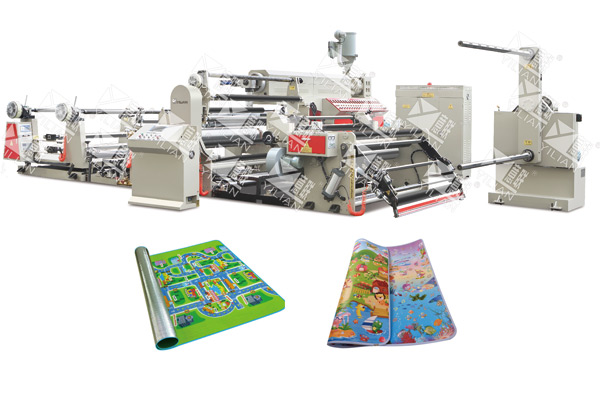
The SJFM1100-2300E Extrusion Film EPE Laminating Machine from Winrich is built around the melt-to-nip process the page describes: 1100–2300mm machine spec, 1000–2200mm coating width, 50m/min production speed, and PE/PP/EVA resin coating onto EPE, BOPP, BOPET, or aluminum foil at 0.012–0.1mm thickness. The Φ800–1300mm main unwind and the ≤±5mm net film tolerance round out the working envelope. For a converter producing foam-based packaging, insulation facing, or foil-laminated structures, the Extrusion Coating Lamination Machine value sits in the direct melt bond—there's no adhesive layer to dry, and the resin layer that carries the seal or barrier function is formed in the same pass that bonds the substrates together.
What to confirm before matching a structure to the line
Confirm the substrate combination against the EPE/BOPP/BOPET/AL list, the resin against the PE/PP/EVA options, and the coating thickness against the 0.012–0.1mm range. The 50m/min speed is a machine-level figure—the actual line rate depends on the resin, the coating thickness, and the substrate's heat sensitivity. A trial on the actual structure is the step that confirms the bond strength and the coating tolerance hold at production speed.
Let's Check Your Structure Against the SJFM1100-2300E
Send over your substrate combination, target coating thickness, and required line speed—we'll help you check them against the 1000–2200mm coating width, 0.012–0.1mm thickness range, and PE/PP/EVA resin options. Talk to Winrich about your Extrusion Coating Lamination Machine requirements and get a structure-level answer before you commit to the line.