Troubleshooting Low Bond Strength on Extrusion Coating Lamination Line
Datetime: 7/2/2026 3:05:00 PM Visit: 483
You’ve run a batch through your extrusion coating lamination line, and the bond isn’t holding. Two layers peel apart with almost no resistance. The finished product—whether it’s a liquid packaging carton, a medical pouch, or a non-woven composite—is headed for the reject bin.
Low bond strength is one of the most frustrating problems in extrusion lamination, and it’s rarely a single-cause issue. More often, it’s a combination of factors: melt temperature that never reached the substrate, nip pressure that’s uneven or insufficient, surface treatment that’s degraded, or substrate contamination that’s invisible to the eye. Your Extrusion Coating Lamination Machine is capable of producing high-quality laminates, but when the process parameters drift, the bond strength drops—and fast.
This article walks through five probable causes in order of how often they appear, gives you a simple test to confirm each one, and shows you how to fix it. For production technicians and line supervisors, this is practical troubleshooting you can use on your next shift.
First – Is Your Melt Temperature Really Where It Should Be?
The adhesive—whether it’s LDPE, PP, EVA, or a specialty resin—needs to hit a specific temperature window to bond properly. Too low, and it doesn’t wet the substrate. Too high, and it oxidizes and becomes brittle.
Check Actual Temperature, Not Setpoint
The controller might say 320°C, but the melt at the die lip could be 20°C lower. Use a surface pyrometer or an infrared thermometer to measure the melt temperature as it exits the die. For LDPE, the melt temperature should typically be between 280°C and 320°C. For EVA and other copolymers, the window is narrower.
The 5°C Increment Test
Don’t guess. Raise the melt temperature in 5°C increments and run a small batch at each setting. Peel-test each sample. The temperature that gives you the highest peel strength is your target. Mark it down and lock it in.
Watch for Residence Time
If the extruder is running too slow for the barrel size, the resin sits in the barrel too long and degrades. Degraded resin doesn’t bond. Match your screw speed to the output rate. The SJFM series is designed with precise temperature control systems that help maintain consistent melt quality across a range of production speeds.

Second – Surface Treatment: The Hidden Variable
Extrusion coating relies on the molten polymer bonding to the substrate surface. If that surface doesn’t have enough polarity, the bond won’t form.
The Dyne Test
Use a dyne test pen or dyne solution to check the surface energy of your substrate before it enters the nip. For most extrusion coating applications, you need a surface energy of at least 38-40 dynes/cm. If it’s lower, the resin won’t wet out properly.
Corona Treatment Degradation
Corona treaters lose effectiveness over time. The electrode gets dirty. The gap drifts. The power supply drops. Check your corona treater output regularly—not just the display, but actual treatment level on the web. If you see inconsistent treatment across the width, the treater needs maintenance.
Flame Treatment for Paper Substrates
For paper-based substrates—like those used in milk cartons or syrup boxes—flame treatment can burn off surface fibers that interfere with bonding. If you’re running paper and seeing weak spots, consider adding a flame treater or checking your existing one.
Third – Nip Pressure: Too Little, Too Much, or Uneven
The nip is where the molten polymer meets the substrate. If the pressure isn’t right, the bond isn’t right.
The Carbon Paper Test
Place a sheet of carbon paper face-down between two pieces of plain paper. Run it through the nip. The impression left on the paper shows you the pressure distribution across the width. If you see gaps or light areas, the pressure isn’t uniform.
Check the Nip Roll Condition
Worn or damaged nip rolls create low-pressure zones. Inspect the roll surface for flat spots, scoring, or uneven wear. If the roll is glazed or hardened, it may need to be reground or replaced.
Pressure vs. Bond Strength Relationship
Too little pressure and the resin doesn’t make full contact with the substrate. Too much pressure and you squeeze out the molten resin before it can wet the surface. The right pressure is the one that gives you maximum peel strength without crushing the substrate. For non-woven and paper substrates, the window is narrower than for film.
| Symptom | Likely Cause | Quick Test |
|---|---|---|
| Weak bond across entire width | Melt temperature too low | Measure melt temp at die |
| Weak bond in streaks or patches | Uneven nip pressure | Carbon paper test |
| Weak bond only on one side | Corona treater uneven | Dyne test across width |
| Weak bond with brittle feel | Melt temperature too high | Lower temp in 5°C steps |
| Intermittent weak spots | Substrate contamination | Wipe substrate with solvent, retest |
Fourth – Substrate Contamination and Finish
The substrate itself can be the problem—and it’s often the last thing you check.
Spin Finish and Additives
Non-woven fabrics and some films come with spin finish, antistatic agents, or slip additives. These create a barrier layer that prevents the molten resin from bonding. The effect is subtle: the substrate looks clean, but the bond is weak.
The Solvent Wipe Test
Take a piece of uncoated substrate. Wipe it with acetone or isopropyl alcohol. Let it dry. Run it through the line with the same settings. If the bond strength improves, you’ve confirmed contamination. The fix is either a different substrate grade or an online plasma or corona treatment before the nip.
Moisture Content
Paper and non-woven substrates absorb moisture from the air. When moisture flashes to steam at the nip, it creates voids in the bond line. If your substrate moisture content exceeds 6-8%, you’ll see weak spots and pinholes. Measure moisture content with a handheld meter or oven test. Add a pre-heat roll or infrared heater to drive off moisture before the nip.
Fifth – Cooling and Winding: The Post-Nip Factors
The bond isn’t fully formed when the web leaves the nip. What happens next matters.
Premature Cooling
If the web hits a chill roll too soon, the polymer doesn’t have time to wet the substrate fully. The bond forms on the surface instead of penetrating the substrate. If you have the option, extend the distance between the nip and the first cooling roll, or reduce the chill roll temperature differential.
Winding Tension
Too much tension on the rewind can delaminate a weak bond. If you’re seeing edge peeling or layer separation on the roll, check your rewind tension. Reduce it gradually until the separation stops, then lock it in.
Blocking
If the coated side sticks to the back side of the web on the rewind roll, you’ve got blocking. This is usually a cooling issue—the coating isn’t set before it hits the roll. Increase cooling or reduce winder tension.
A Systematic Test – Single Factor Variation
Don’t change multiple parameters at once. You’ll never know which one fixed the problem.
Design a Simple DOE
Fix the nip pressure and line speed. Run samples at five different melt temperatures, 5°C apart. Peel-test each sample. Plot the results. The temperature that gives you the highest peel strength is your target.
Record the Results
Once you’ve found the right combination, document it. Record melt temperature, nip pressure, line speed, corona treater setting, and substrate lot. If the problem comes back, you have a baseline to compare against.
Build a Bond Strength Log
Take a sample every shift. Run a 180° peel test with a simple pull gauge. Plot the results on a control chart. If you see a trend—three points going down—you can intervene before the line produces rejects.
Questions from the Field
Is higher peel strength always better?
No. If the peel strength is too high, the failure mode shifts from adhesive (peeling at the bond line) to cohesive (tearing the substrate). For non-woven and paper substrates, this means the fabric tears before the bond breaks. That’s not necessarily a problem, but it can make the material harder to process downstream. Target a peel strength that meets your specification—not the highest possible number.
Can the same parameters work for both PP and PET substrates?
Not usually. PP and PET have different surface energies and thermal properties. PP typically requires higher melt temperatures and more aggressive surface treatment. PET bonds more readily but is more sensitive to moisture. Always run a trial when you switch substrate types, and document the settings for each.
How often should we recalibrate the nip pressure gauge?
At least once a month, or whenever you notice inconsistent bonding. The gauge itself may be accurate, but the mechanical linkage, air cylinders, or hydraulic system can drift. Use the carbon paper test as a quick verification—if the pressure pattern changes, recalibrate.
Building a Reliable Extrusion Lamination Process
Low bond strength is solvable. It just takes a systematic approach.
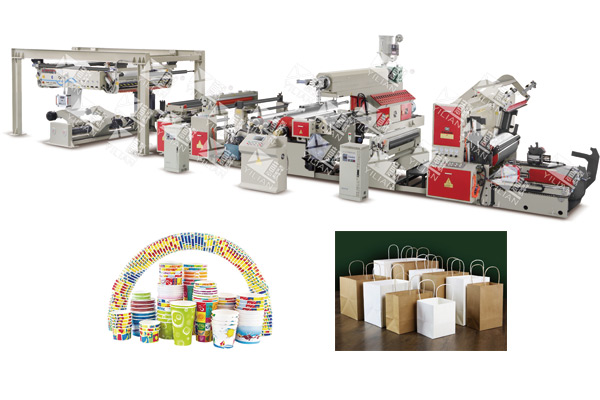
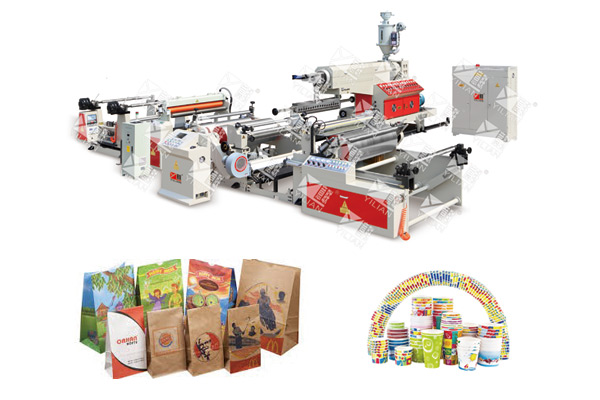
Winrich Machinery manufactures extrusion coating and laminating machines designed for precision and reliability. The SJFM 1300D-2600D Extrusion Coating and Laminating Machine (Auto Unload) is one of their key models—a machine that can finish coating double-sided film at a time, making it one of the most advanced in China. It’s used for coating and laminating products that require double-sided film or multi-layer application in a single pass, such as milk boxes, syrup boxes, and drink boxes.
The machine is built with precision machining centers that ensure high-quality components tailored to extrusion coating laminators. Winrich offers a wide range of customization options for machine specifications, including colors, sizes, and specific requirements. Their assembly team has over 20 years of expertise in manufacturing these machines to exacting standards. Each machine undergoes rigorous testing before shipment to ensure superior quality assurance.
For production teams, the key to consistent bond strength is a disciplined approach: check melt temperature at the die, verify surface treatment with a dyne test, inspect nip pressure with carbon paper, and test substrate cleanliness with a solvent wipe. Document everything. Build a bond strength log. When you see a trend, intervene before it becomes a problem. Winrich offers comprehensive after-sales service, including technical support and 24/7 consulting support, to help you maintain optimal operational efficiency.
Low bond strength doesn’t have to be a recurring headache. With a systematic troubleshooting process and regular maintenance, your extrusion coating lamination line can produce consistent, high-quality laminates shift after shift.
Need help troubleshooting your extrusion coating lamination line? Reach out to Winrich Machinery's technical team—they can provide process optimization guidance, spare parts support, and on-site assistance to keep your line running at peak performance.